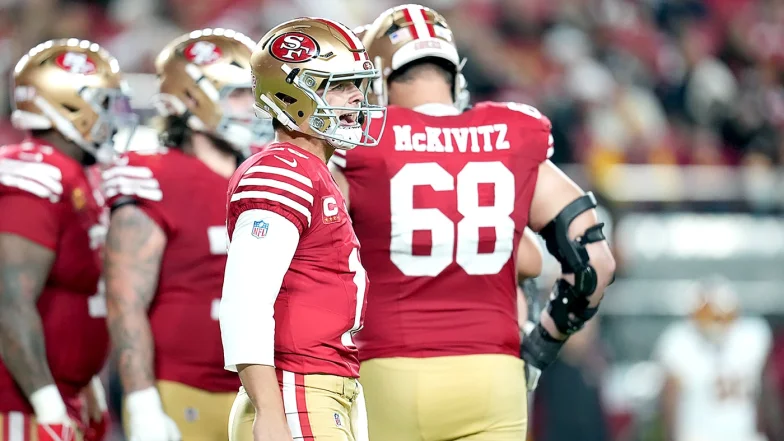
San Francisco 49ers head coach Kyle Shanahan doesn't always know when quarterback Brock Purdy fails to hear a play call. Sometimes, he doesn't find out until someone on the sideline alerts him. By then, the clock is ticking, and the 49ers have a decision to make.
The issue came to light on Monday Night Football against the Washington Commanders when Purdy was seen yelling toward the sideline. Some immediately assumed the quarterback was telling his play-calling head coach to hurry up with his call. But that wasn't the case. It was merely issues with the headsets.
Shanahan discussed the communication issues that surfaced during Monday night's game, explaining to NBC Sports Bay Area's Matt Maiocco how the system works and what happens when Purdy can't hear the play call in time. According to Shanahan, it's not an uncommon occurrence.
"What people saw last week, it happens a lot, about two to five times a game," Shanahan said. The problem isn't necessarily the crowd noise, either. Shanahan compared it to a dropped or interrupted cell phone call, explaining that the communication can occasionally cut out even when conditions seem fine.
There's also a brief delay built into the process. When Shanahan presses the button to communicate with Purdy through his helmet, both hear a loud beep. Shanahan has to wait for that beep to finish before delivering the play call. If Purdy doesn't hear the message, Shanahan might not immediately realize it.
"I've already let go of the button because I already called it," Shanahan explained. "He can't talk back. So I don't know if he doesn't hear. And then I'm just sitting there chilling, and someone will usually tap me on my shoulder and be like, 'Brock didn't get it.'"
At that point, Shanahan has to press the button again, wait for the beep, and relay the call a second time. The bigger problem is the play clock. Once it reaches 15 seconds, the communication system shuts off, leaving Purdy without the ability to receive another play call from his head coach.
The 49ers have a contingency plan for that situation. Purdy has an automatic play call he can use if the communication fails, giving the offense an option rather than forcing it to scramble without direction. Still, Shanahan must decide whether that play is worth running or whether it's better to use a timeout.
"I'd say 60% of the time, I'll probably call a timeout," Shanahan said.
The decision depends on the situation, including how much time remains, how many timeouts San Francisco has available, and whether Shanahan likes the automatic play call. Sometimes, he'll let Purdy run it. Other times, he would rather stop the clock than risk a play he doesn't particularly like in that situation.
Shanahan said the automatic call is generally a universal play the team uses throughout the season. If it proves ineffective against a particular opponent, the 49ers can change it.
The goal, of course, is to avoid the situation altogether. But Shanahan acknowledged that communication problems are simply something teams occasionally have to manage.
Maiocco also asked whether Purdy can change the play on his own if he recognizes that the automatic call might not work against the defensive look in front of him.
"As long as it works, he can do whatever the hell he wants," Shanahan said. "But if he just says something on his own and it sucks, then no, it's not cool."
Shanahan was joking to a degree, but his point was clear. He wants Purdy to use his judgment and make the offense better when he sees an opportunity. That freedom comes with responsibility, particularly when the quarterback is making a decision without the benefit of a fresh play call from the sideline.
The 49ers also frequently give Purdy multiple plays at the line of scrimmage, allowing him to switch between options based on the defensive alignment. Shanahan estimated that roughly half of San Francisco's play calls include an alternative, with the system used more often in the running game than in the passing game.
The 49ers call it a "can system." When Purdy switches to the second play, fans can sometimes see him touch his ears as he communicates the change to his teammates. That system gives San Francisco flexibility at the line of scrimmage, but it's separate from the problem that occurs when the helmet communication fails.
For the 49ers, the solution in those moments comes down to preparation, an established fallback play, and Shanahan's judgment about whether the situation warrants spending a timeout. It's not the sort of issue that usually attracts much attention until something goes wrong during a game. Monday night offered a reminder that even a well-designed offense can run into communication problems, and the 49ers have a process in place to deal with them.
Watch Maiocco's full interview with Shanahan below:
More info on: Brock Purdy
Comments