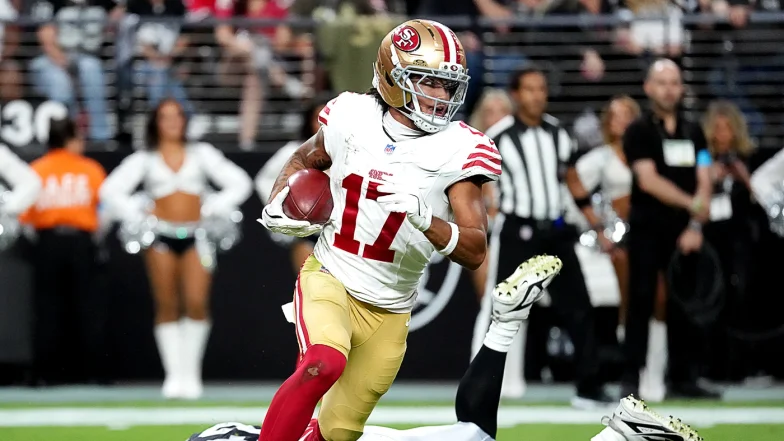
Kyle Shanahan has spent much of this season finding ways to win despite injuries, and Sunday's game against the Atlanta Falcons presents another unusual situation. The 49ers are down to four primary wide receivers, but Christian Kirk, Brandin Cooks, Jordan Watkins, and Jacob Cowing give Shanahan an unexpected weapon: speed.
Kirk was activated Saturday, just in time for his 49ers debut, joining a receiving group that has barely played together. Cooks brings more than a decade of NFL experience, while Watkins and Cowing still need to establish themselves.
They may not be the receiving corps Shanahan envisioned, but their speed could give him some interesting options against the Falcons.
Four Receivers Who Can Run
Cooks entered the NFL with a 4.33-second 40-yard dash at the 2014 Combine. He's 33 now, and that number certainly doesn't reflect his speed today. Still, he can get downfield, as he demonstrated with Buffalo last season when he caught four passes for 101 yards against Philadelphia.
His six 1,000-yard receiving seasons also give Shanahan an experienced receiver who knows how to create separation and recognize what defenses are trying to take away.
Kirk brings similar experience, along with game speed that goes beyond his 4.46-second pre-draft 40-yard time.
During Houston's playoff victory over Pittsburgh last January, Kirk caught eight passes for 144 yards and a touchdown. According to NFL Next Gen Stats, he reached 20.05 mph on a 46-yard reception and 19.64 mph on another 36-yard catch. Those were among the fastest recorded speeds of the playoff weekend and would have ranked among the fastest for a 49ers ball carrier last season.
After missing San Francisco's first six games with a calf injury, Kirk returns with plenty of football experience but little time on the field with Brock Purdy. Offensive coordinator Klay Kubiak praised his preparation during the week, and Purdy has expressed confidence in his readiness.
Watkins and Cowing are even closer to Cooks' original 40-yard time. Watkins ran 4.37 at the 2025 Combine, while Cowing ran 4.38 the previous year.
Watkins impressed as a rookie during training camp last season before injuries interrupted his development. His opportunities have remained limited, although his three receptions this year have produced 82 yards, an average of 27.3 yards per catch.
Cowing has had even fewer chances. After catching four passes as a rookie in 2024, he missed all of 2025 and has primarily contributed as a punt returner this year.
Neither has established himself as a consistent NFL receiving threat, but both possess speed that Shanahan hasn't had much opportunity to use.
Making the Falcons Defend the Entire Field
Shanahan doesn't need all four receivers catching deep passes to take advantage of their speed.
His offense uses motion and crossing routes to force defenders to move, communicate, and sometimes follow receivers away from the area where the play is headed. With four fast receivers, Shanahan can threaten the Falcons across the field while still making the defense respect the deep pass.
That could be particularly useful against a Falcons defense that can generate pressure without relying heavily on blitzes.
Quick throws to receivers crossing the formation could help Purdy get the ball out before the rush arrives. Shanahan could also use motion to create favorable matchups, giving his receivers opportunities to catch the ball while already moving rather than asking them to beat defenders from a standing start.
Christian McCaffrey could benefit if the Falcons' defensive backs have to respect the receivers' ability to get behind them. Keeping a safety deeper or forcing defenders to hesitate before attacking the line of scrimmage can give Shanahan more room to work with in the running game.
George Kittle could also find opportunities underneath if the Falcons commit more attention to the outside speed.
Cooks and Kirk bring the experience to recognize coverage adjustments, while Watkins and Cowing give Shanahan younger legs that can stretch the defense. Even when they don't get the ball, their speed can force defenders to adjust and create opportunities for someone else.
Speed Still Has to Work Within the Offense
Shanahan also asks his receivers to do considerably more than run routes.
Blocking is particularly important on outside runs and screens, where a receiver's ability to engage a defensive back can decide whether a play gains a few yards or breaks into the open field.
Pro Football Focus gave Kirk a 67.2 run-blocking grade in 2025. Cooks has a 60.7 grade this season, followed by Watkins at 58.0 and Cowing at 44.3. The 2026 grades come from limited blocking snaps, so they provide some evidence of individual performance without establishing how effectively this group will execute together.
Timing with Purdy presents another challenge. Kirk is making his 49ers debut, Cooks is still relatively new to the offense, and Watkins and Cowing have combined for only nine career receptions.
Speed won't overcome a missed assignment or a receiver running a route differently than Purdy expects.
Shanahan has veterans in Kirk and Cooks, two young receivers with largely untapped potential, and an offense built to create space for its playmakers.
He doesn't need all four receivers to have big games against the Falcons. If their speed helps open running lanes for McCaffrey, creates opportunities for Kittle, or helps Purdy find open receivers before the pass rush gets to him, Shanahan will have found another way to make the most of the players he has available.
More info on: Brandin Cooks, Jacob Cowing, Christian Kirk, George Kittle, Christian McCaffrey, Brock Purdy, Jordan Watkins
Comments