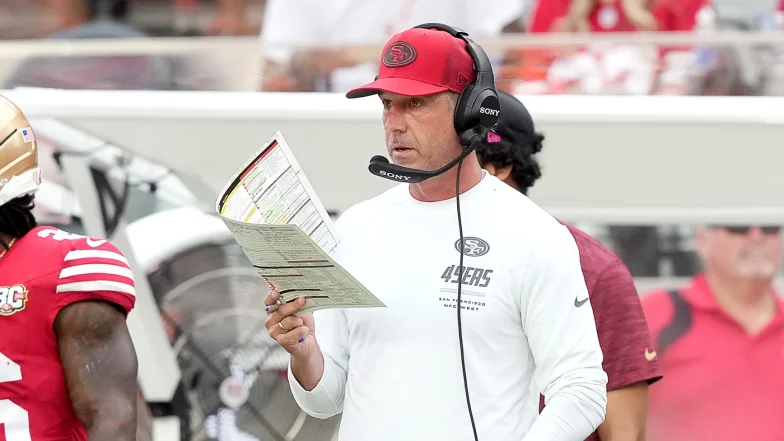
Six games, six wins. The San Francisco 49ers are one win away from entering their bye week undefeated, something few expected given the injuries they've endured. But with Mike Evans, Nick Bosa, and Deebo Samuel unavailable for Sunday's game against the Atlanta Falcons, reaching 7-0 will require another collective effort.
San Francisco could enter the game with just four available wide receivers: Christian Kirk, Brandin Cooks, Jordan Watkins, and Jacob Cowing. Kirk is expected to make his 49ers debut, but the group has barely played together, leaving Brock Purdy with limited options beyond Christian McCaffrey and George Kittle.
The roster situation could also leave the 49ers with fewer than their usual 48 active players, forcing the coaching staff to prepare for players potentially taking on unfamiliar responsibilities if another injury occurs.
Atlanta has its own problems, though. The Falcons have struggled to protect Michael Penix Jr., their aggressive defensive front has been vulnerable against the run, and their offense has struggled to adjust when opponents take away its preferred approach.
The 49ers have enough talent to exploit those weaknesses, but with so many players missing, they'll need contributions from throughout the roster.
Establishing the Running Game
With Evans and Samuel out, San Francisco may have to rely more heavily on McCaffrey and its offensive line. Fortunately, the running game has been one of the team's most consistent strengths.
The 49ers rank sixth in rushing, and only 4.3 percent of their running plays have resulted in lost yardage. That ability to consistently gain ground has helped keep the offense in manageable situations, even when a play doesn't produce a significant gain.
Atlanta's defensive front presents an interesting matchup. The Falcons generate pressure on opposing quarterbacks at one of the league's highest rates despite rarely blitzing. Their aggressive one-gap approach lets defenders attack the backfield, but it has also created openings in the running game.
Both Baltimore and Chicago exploited those openings, producing significant gains on the ground while Atlanta struggled to adjust. With the Falcons also dealing with linebacker injuries, McCaffrey and the offensive line could have opportunities to do the same.
But Atlanta's ability to pressure quarterbacks without sending extra defenders could become a problem if San Francisco falls behind the chains.
Against Washington on Monday night, the 49ers built a 20-3 halftime lead before their offense stalled, managing just 72 yards in the second half. With Evans sidelined, Washington increased the pressure, and sacks turned manageable situations into difficult third downs.
San Francisco cannot afford another extended slowdown against a defense that can generate pressure with four rushers. Even modest gains on early downs would help Shanahan maintain offensive balance and give Purdy more manageable passing situations.
Making the Most of Limited Receiving Options
Atlanta's ability to pressure quarterbacks with four defenders also allows the Falcons to keep more players in coverage, making life difficult for a receiving group that has barely played together.
Kirk's expected return should help, although it would be unrealistic to expect him to immediately replace Evans' production after missing the first six games. Cooks brings experience, while Watkins and Cowing provide different options depending on the coverage and the routes Shanahan wants to attack.
Watkins has already started games this season, and although his production has been limited, he continues earning opportunities. Cowing's quickness could also give Purdy an option underneath, especially if Atlanta focuses on preventing deep throws.
McCaffrey and Kittle will remain central to the passing game, but their importance also creates a challenge. Atlanta knows Purdy relies on both players, and the Falcons could concentrate additional attention on them if the other receivers struggle to get open.
Shanahan can counter by moving McCaffrey around the formation, using motion to create favorable matchups and potentially opening opportunities for Kittle or the receivers.
Purdy will need to distribute the football based on what the defense gives him rather than forcing throws to his preferred targets. That may require the receivers to make the most of limited opportunities, especially if Atlanta begins committing more defenders to stopping McCaffrey.
Pressure on Penix Could Give San Francisco an Advantage
While Atlanta's defense can create problems for Purdy, the Falcons have experienced even greater difficulties protecting Penix.
Penix has completed just 31 percent of his passes when pressured this season, compared with 78 percent when operating from a clean pocket. That's a significant difference for a quarterback still adjusting to a new offensive system.
Under Kevin Stefanski, Atlanta has incorporated more plays with Penix under center, relying heavily on play-action and Bijan Robinson to create passing opportunities. The approach worked well initially, but opposing defenses have adjusted, and the Falcons have struggled to respond.
Chicago blitzed Penix on 56 percent of its defensive snaps last week and recorded five sacks. Atlanta's offensive tackles have also struggled in pass protection, giving San Francisco opportunities to disrupt the passing game even without Bosa.
The 49ers have generated pressure on 51 percent and 46 percent of opposing dropbacks over their last two games, showing their pass rush has kept producing despite injuries.
Several players have contributed to Raheem Morris' defense, including Romello Height, whose speed off the edge could trouble Atlanta's offensive tackles.
But San Francisco cannot become so aggressive pursuing Penix that it leaves openings for Robinson.
Robinson enters the game with 641 rushing yards and a 5.8-yard average per carry, and Atlanta relies heavily on him to establish its offense. His ability to change direction, break tackles, and contribute as a receiver makes him dangerous even when the defense appears to have him contained.
Fred Warner and the defense will need to stay disciplined, limiting Robinson's opportunities while preventing Penix from connecting with Drake London and Kyle Pitts downfield.
If San Francisco can contain Robinson on early downs, it will have more opportunities to pressure Penix in obvious passing situations. Given Atlanta's difficulties adjusting when opponents take away its running game, that could become one of the 49ers' biggest advantages.
Turnovers and Special Teams Could Decide a Close Game
Despite Atlanta's struggles, the Falcons have enough offensive talent to make Sunday's game competitive. With San Francisco missing several offensive weapons, I wouldn't be surprised if this becomes a relatively low-scoring contest.
If that happens, turnovers, field position, and special teams execution could play a significant role.
Atlanta enters Sunday with a minus-seven turnover differential, compared with San Francisco's plus-one. Penix's struggles under pressure could give the 49ers chances to create takeaways, but Purdy must be equally careful against a defense that can generate pressure without blitzing.
San Francisco also needs to avoid repeating the mistakes that nearly cost it against Washington. The 49ers lost a fumble, committed 11 penalties for 88 yards, and missed an extra point Monday night. They still won, but those mistakes helped keep Washington within striking distance.
Special teams have been a concern at times this season, particularly with missed kicks and problems in punt coverage and returns. But the unit has also provided advantages.
The 49ers have also benefited from strong punting and kickoff returns, averaging a start around their own 32-yard line, one of the best marks in the league.
That difference could become valuable if both teams are forced to sustain long possessions rather than relying on explosive plays. Starting several yards closer to midfield can influence play-calling, field-goal opportunities, and how much ground an offense needs to cover.
San Francisco doesn't need a spectacular special teams play to win. Reliable kicking, sound coverage, and avoiding unnecessary mistakes could make the difference in a close game.
One More Before the Bye
Sunday's matchup comes on a short week for San Francisco, with the team traveling across the country after Monday night's victory over Washington. The early kickoff also means the 49ers will be playing at 10 a.m. Pacific time, adding another challenge before their much-needed bye.
For a team dealing with so many injuries, the opportunity to rest couldn't come soon enough. But Atlanta, sitting at 2-4, has its own reasons to play with urgency.
The Falcons have been inconsistent, but they've shown enough talent to be dangerous when their offense clicks. Robinson can control the clock, London and Pitts can produce explosive plays, and their defense can disrupt Purdy even without blitzing.
San Francisco also has a difficult history playing regular-season games in Atlanta, losing its last four visits. That won't determine Sunday's outcome, but it underscores the challenge of winning on the road against a team that can play better than its record suggests.
Still, the 49ers have advantages they can exploit. Their running game matches up favorably against an Atlanta defense that has allowed big gains on the ground, while their ability to generate pressure could create problems for Penix.
The Falcons can win if Robinson controls the game, Penix connects on explosive plays, and their defense forces San Francisco into difficult passing situations. But the 49ers have enough to prevent that from happening.
They've reached 6-0 by finding ways to win with the players available. Sunday's game will require another collective effort, with the offense sustaining drives, the defense limiting Atlanta's biggest weapons, and special teams avoiding mistakes that could change the outcome.
The bye week will give San Francisco an opportunity to get healthier. A seventh consecutive victory would make that week of rest even more rewarding.
More info on: Nick Bosa, Brandin Cooks, Jacob Cowing, Mike Evans, Romello Height, Christian Kirk, George Kittle, Christian McCaffrey, Brock Purdy, Deebo Samuel, Fred Warner, Jordan Watkins
Comments