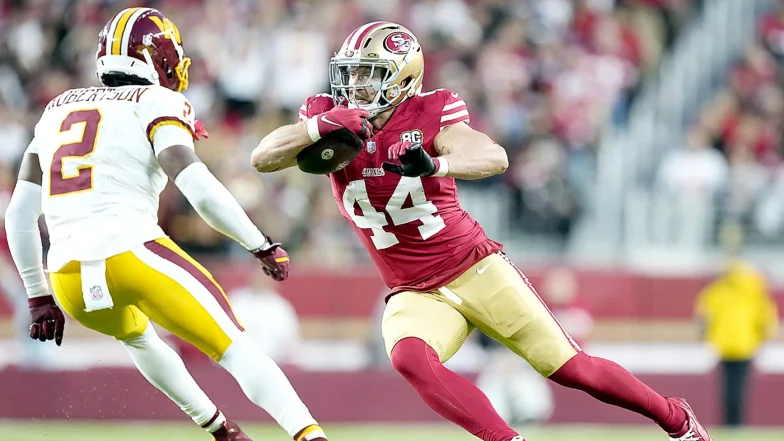
The San Francisco 49ers have taken a different approach to offensive personnel than most NFL teams, and their production shows just how effective that strategy has been.
While most NFL offenses rely heavily on formations featuring three wide receivers, San Francisco has built its offense around two-running-back sets. Through 336 offensive plays, the 49ers have used 21 personnel, which features two running backs, one tight end and two wide receivers, on 35% of their plays. That is the highest rate in the league.
However, the 49ers' use of two-running-back formations comes with an important distinction. The running back category includes fullbacks, allowing San Francisco to utilize fullback Kyle Juszczyk alongside its running backs. While many NFL teams rarely use a traditional fullback, Juszczyk remains an important part of the 49ers' offensive identity.
The approach has helped San Francisco establish one of the NFL's most efficient offenses across several personnel groupings. The 49ers rank first in expected points added per play, yards per play and success rate when using two or more running backs in any personnel, showing that their production is not limited to one specific formation.
The 49ers Are Building Around Two-Running-Back Sets
The most notable aspect of San Francisco's personnel usage is how frequently it puts two running backs on the field.
The 49ers use two or more running backs on 43% of their offensive plays, the highest rate in the NFL. In those situations, San Francisco ranks first in EPA per play at +0.14, yards per play at 5.9 and success rate at 60.3%.
Those numbers demonstrate how effective the offense has been when deploying multiple running backs. Rather than treating a second running back as a situational option, San Francisco has made the approach a central part of its offensive identity.
Fullback Kyle Juszczyk helps make that approach possible. His role allows the 49ers to use a traditional fullback in formations that can create additional blocking opportunities for the running game while still having options in the passing game.
That is particularly important in 21 personnel, the formation San Francisco uses more than any other team. The 49ers deploy it on 35% of their plays and rank first in EPA per play at +0.11, yards per play at 6.4 and success rate at 60.5%.
The formation gives head coach Kyle Shanahan flexibility in how he attacks opposing defenses. With two running backs, a tight end and two wide receivers on the field, San Francisco can threaten defenses with its running game while retaining the ability to throw the football.
Juszczyk's presence also adds versatility to the formation. Defenses must be ready for his blocking ability, but the 49ers can use the same personnel grouping without necessarily committing to a run. That ability to have options can make it more difficult for opponents to anticipate what is coming based solely on the players on the field.
San Francisco Is Efficient Even With Three Receivers
The 49ers' success with heavier personnel becomes even more interesting when compared with their production in traditional passing formations.
Eleven personnel, which features one running back, one tight end and three wide receivers, is the most common personnel grouping in the NFL. San Francisco uses it on just 32% of its plays, the second-lowest rate in the league.
Despite the limited usage, the 49ers rank first in EPA per play at +0.29, second in yards per play at 7.8 and fifth in success rate at 48.6% when using the formation.
The numbers suggest San Francisco does not need to rely on three-receiver sets to generate an efficient offense. However, when the 49ers do use them, they have been particularly productive.
That effectiveness gives Shanahan more ways to attack defenses. San Francisco can use heavier formations to create different matchups before turning to three-receiver sets when the situation calls for them.
The contrast is notable because the 49ers have managed to produce at an elite level without following the personnel distribution most commonly seen around the league.
Tight Ends Give the Offense Another Dimension
San Francisco's tight end usage provides another example of its ability to find production across different formations.
The 49ers use two or more tight ends on 33% of their plays, ranking 20th in the league in frequency. Yet the offense ranks sixth in EPA per play at +0.15 and fifth in success rate at 55.5% in those situations.
The team's production also extends to 12 personnel, which features one running back, two tight ends and two wide receivers. San Francisco uses the grouping on 20% of its plays, ranking 21st in the league, but produces +0.16 EPA per play, 6.7 yards per play and a 58.2% success rate. The 49ers have been less reliant on this grouping than many other teams, but they have still found ways to make it productive.
San Francisco has also experimented with 22 personnel, featuring two running backs, two tight ends and one wide receiver. The team uses that formation on 7.4% of its plays, ranking fifth in the NFL. Among the league's offenses, the 49ers rank first in EPA per play at +0.21 and a success rate at 56% in those situations.
Although the sample sizes for some of these less frequently used formations are smaller, the results show the range of personnel packages Shanahan can use and still have one of the league's most efficient offenses.
A Different Approach Is Delivering Results
The 49ers' offensive personnel usage stands out because of how effectively the team has used different formations rather than relying on one approach.
San Francisco's heavy use of two-running-back sets has produced league-leading efficiency, while its limited use of three-receiver formations has still generated some of the NFL's best results.
Juszczyk's role as a fullback is an important part of that identity. In an NFL where many offenses have moved away from traditional fullbacks, San Francisco continues to use him as a versatile piece of its offensive scheme.
The results do not necessarily mean San Francisco should increase its use of every productive formation. Some groupings have been used on relatively few plays, and their efficiency can change as the sample grows. Still, the current numbers show that the 49ers have been effective across a variety of personnel packages.
In a league where three-receiver formations remain the standard, San Francisco has demonstrated that an offense does not have to follow that trend to produce at a high level.
The 49ers have found a formula that takes advantage of multiple running backs, uses Juszczyk's versatility and makes productive use of tight ends while remaining dangerous when spreading the field. If that versatility continues, it could remain one of the defining strengths of Shanahan's offense.
More info on: Kyle Juszczyk
Comments