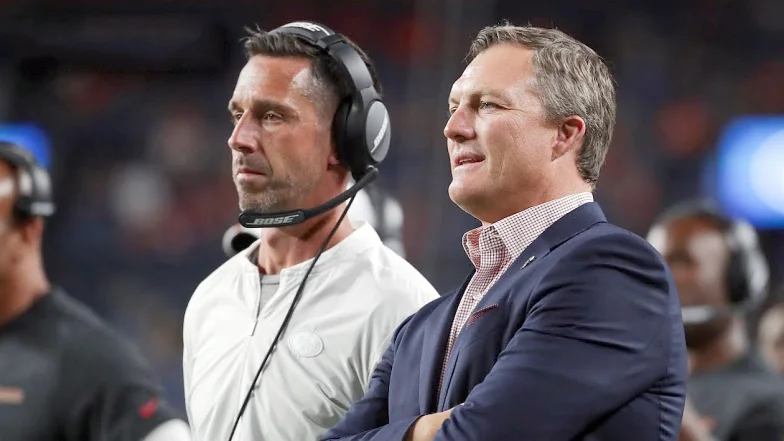
For years, the San Francisco 49ers had a reputation for being one of the easiest NFL teams to get information from. Not because the team was particularly transparent, but because information seemed to find its way out of the building. That changed in 2017.
Since Kyle Shanahan and John Lynch took over, the 49ers have become one of the NFL's best organizations at keeping things in-house. The team has learned to be stingy with certain information until it is ready to announce on its own terms. We've seen it with major moves, like when the 49ers traded for the number-three overall pick in the 2021 NFL Draft, or the trade for Trent Williams in 2020. In both cases, and others, the team was able to keep significant news under wraps until the moment it wanted the information released.
But now, we're looking at something different. According to a report from Pro Football Talk's Mike Florio, Shanahan's July 14 car accident was kept quiet for 11 days. The accident happened on a public highway, emergency personnel responded, and public agencies were involved. Yet the news didn't become public until the 49ers were ready to address it as training camp began. Florio questioned whether members of the media had information but chose to wait for the team's approval before reporting it.
Most fans don't care, but others are asking an interesting question. The 49ers have become quite good at keeping secrets. But is this a good thing? Is it good for the fans? Is it good for journalism? There's a legitimate argument on both sides.
On one hand, Shanahan's accident was a personal matter. He was seriously injured, and there was no immediate indication that his life was in danger. The 49ers may have wanted to give Shanahan and his family time to deal with the situation privately before making it public. That's understandable.
Reporters aren't obligated to turn every piece of information they hear into an immediate headline. There are times when discretion is appropriate, particularly when someone's health or personal well-being is involved. The last thing a journalist or beat writer wants to do is rush an article that may include incorrect information.
Those on the other side of this will tell you this wasn't simply a private matter involving a private citizen. Shanahan is the head coach of an NFL team. His availability directly affects the 49ers, their players, their coaching staff and, ultimately, the team's ability to prepare for a season. The accident left Shanahan with multiple injuries, including a concussion, broken ribs, a broken nose and a hand injury, and he is now expected to have a limited role as training camp begins.
That makes the question of when the information should have been reported more complicated. The media's responsibility is to its readers and viewers, not to the teams it covers. That's not to say reporters should burn every source or immediately publish every rumor they hear. Relationships matter. Trust matters. There are legitimate reasons for a reporter to hold a story while confirming details or determining whether reporting it serves the public interest.
But there's a difference between a reporter independently deciding to wait and a team effectively deciding when the media is allowed to report something. If that is the case, it should concern anyone who cares about journalism—or the fans.
The 49ers have built an impressive culture of secrecy since Shanahan and Lynch arrived. From a football standpoint, that's a competitive advantage. From a public-relations standpoint, it's good team management.
But journalism has a different responsibility. If reporters routinely agree to sit on legitimate news until a team permits them to publish it, the relationship between the team and the media begins to change. The reporter risks becoming less of an independent journalist and more of an extension of the organization's communications strategy. And that's a dangerous line to cross.
The 49ers should absolutely be allowed to protect their competitive interests. They should be allowed to control announcements about trades, signings and other transactions when league rules permit it. They should also be allowed to protect the personal privacy of their employees when appropriate.
But when a significant event has already happened, and the information is legitimately newsworthy, the media should be free to make its own editorial decision about when to report it. Because the job of the media isn't to wait for a team to decide when the public is ready to know. It's to determine what the public needs to know, verify it, and report it responsibly.
The 49ers have every right to protect their secrets. But sometimes it may not be a good thing. That's the difficult line reporters must walk.
Comments